| Solar Electric
Project |
|||||||||
|
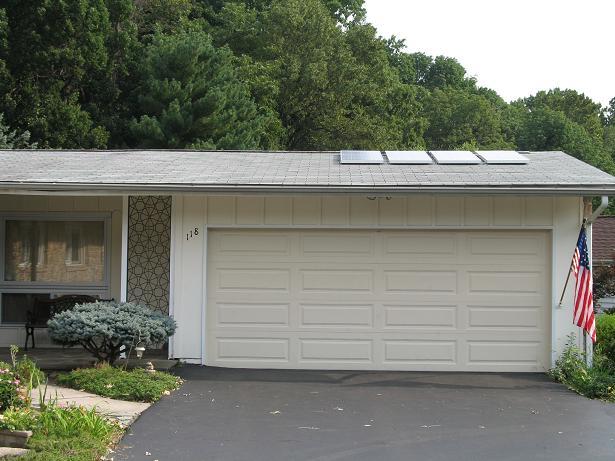
There are lots of great reasons to supplement your home energy needs with solar power. They include the ability to offset rising natural gas and electricity costs (that will continue as our limited fossil fuel reserves are exhausted) as well as taking care of our planet's environment. In addition, solar power provides a backup when conventional power sources go down. Best of all, there is a lot of fun, satisfaction and independence that comes from adding solar energy to your lifestyle. It is a fun hobby with lots of environmental and economic payback! Brad and I installed a PV electric system in August of 2008. Now, when the sun is shining we are cranking out nearly 500 watts of power thanks to 4 Sharp, 123 watt panels! That's more than enough to run a small refrigerator, my solar water pump and charge the 200 Ah AGM battery! I appreciate all the advice and input I received along the way, and a special thanks to Dave, N3HCN who was a guiding force throughout. Here are a few pictures:
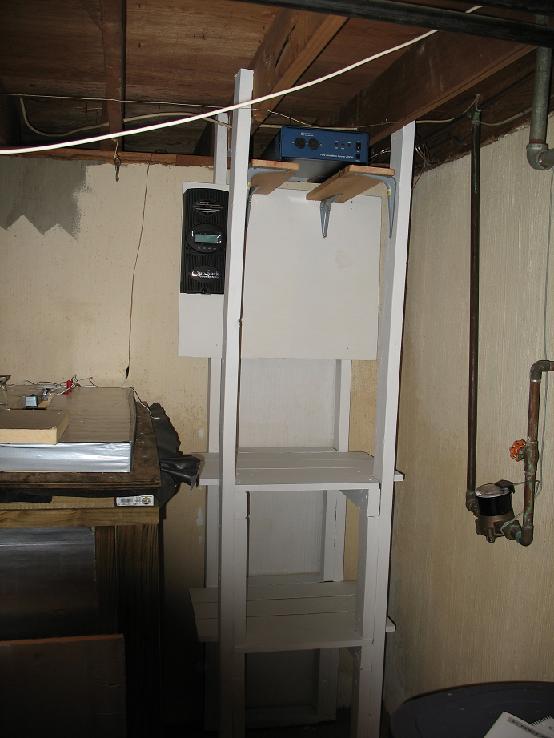
First I built shelves for the battery(s) and an area to mount the components. The Outback charge controller is at the left and the 2 KW inverter is at the top.
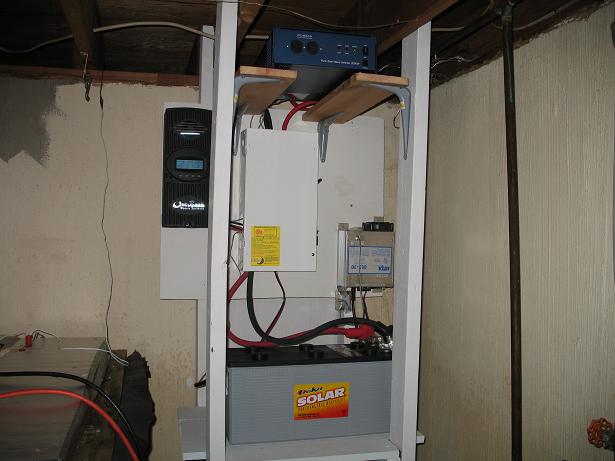
All the components connected and running (The IOTA AC battery charger is in reserve if needed).
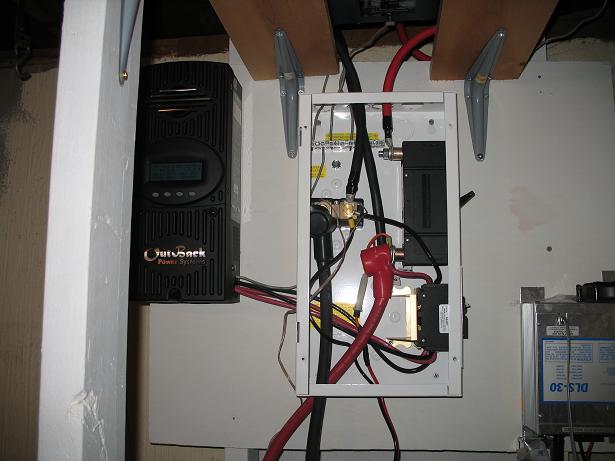
Inside the circuit breaker box.
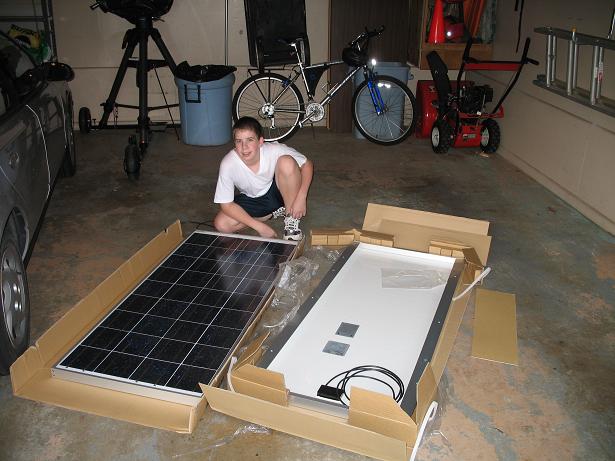
It was an exciting day when the panels arrived!
The panels make a nice, clean install on the garage roof.
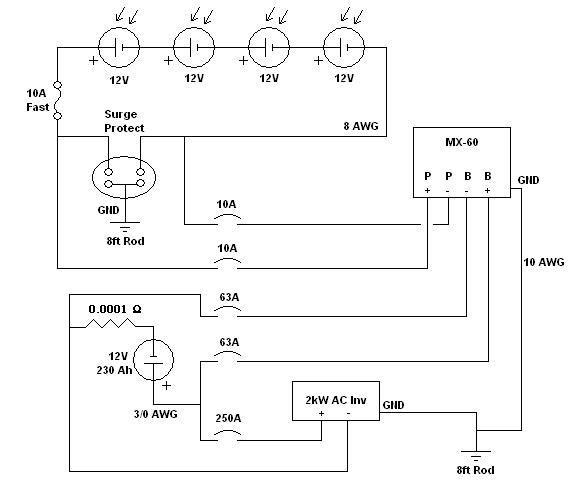
A schematic of the project courtesy Dave, N3HCN.
This project was not only a success from a practical point of
view, it was a lot of fun and a great learning experience for Brad and me. If
you have an interest in something like this, I'll be happy to answer any
questions that you may have.
One piece of advice I would highly recommend is to build any solar electric project you have in mind around the Outback, MX 60 Charge Controller. It is more expensive than other controllers, but completely flexible and programmable, and will actually save you money overall. For example, I opted for a single battery 12 V system, but I also wanted the voltage as high as possible (amps as low as possible) coming from the panels so that I wouldn't have to spend a lot for huge gauge wire. Not a problem for the MX 60. The panels are wired in series and cranking out more than 70 volts, but the MX 60 is perfectly happy using that power to charge the 12 V battery. The MX 60 also has a nice display showing lots of data including both PV and battery watts, volts and amps as well as other data, so that saves the expense of buying a separate meter. If I ever decided to go to a 24 V or 48 V system in the future,
not a problem for the MX 60. A quick programming change from the keypads on
front and I'm ready to roll! SimplySolar - Solar Forum and E-mail Groups! It
turns out that there are other folks like me who also enjoy
sharing ideas and learning from each other's experiments! If you have an interest in brainstorming
solar projects that are easy and inexpensive to build and
neighborhood friendly, or want some help with a project that you have
underway, please join us!
I originally set up an e-mail group - SimplySolar, for that purpose. The e-mail group has served us well, but with overwhelming growth and interest in the e-mail group, to better keep content organized and give members the option to easily follow only the threads that interest them, we have just set up a new Simply Solar on line forum! SimplySolar is about brainstorming and sharing ways to implement solar heat in easy ways that the average homeowner, who may not be much of a "do-it-yourselfer" (like me), can use to put money back in their pockets, green back in the environment and have a lot of fun along the way! If solar excites you, we would love to have you join our forum: Click to visit or join the Simply Solar Forum or subscribe to our e-mail group!: Again, please let me know if you have any questions.
|